Is It Possible to Grow Your Baby in a Lab

Illustration by Toby Leigh
For two tense weeks in mid-2013, developmental biologist Magdalena Zernicka-Goetz was chasing a world tape. She and her colleagues at the University of Cambridge, UK, were attempting to grow human embryos in the lab for longer than had ever been done before. They wanted to glean insights into how a tiny blob of cells transforms itself into a circuitous, multipart structure. Previous efforts had stalled after about a week, just Zernicka-Goetz knew there was much more to learn about human development beyond that bespeak.
The researchers started with embryos that had been donated by women who no longer needed them for in vitro fertilization (IVF) procedures. The team bathed the cells in a special medium and housed them in an incubator, using methods adapted from their previous piece of work on mouse embryos. Because the samples had to stay in a strictly controlled environment, the scientists could remove them simply once or twice a twenty-four hours to rail their progress under a microscope.
The days ticked by — six, seven, eight. And all the same, the embryos continued to thrive and developane. "Nosotros would hold our breath," recalls Zernicka-Goetz. "Each day was more than and more exciting." The squad reached 12 days on its kickoff effort, somewhen stretching to thirteen. "This was just unbelievable. I was then delighted," she says.
Their accelerate, and a similar feat by a group based in New York Citytwo, is 1 of a few achievements in the past 5 years to heat up the study of early human development. Researchers' access to the homo embryo has always been limited, and they knew relatively little about its early transformations. Just now, refinements in prison cell-culturing methods are enabling them to grow human embryos outside of the trunk for up to two weeks. Scientists are using gene-editing techniques, such as CRISPR, and edifice artificial embryo-similar structures to explore the cellular signals and concrete forces that shape the embryo and its supporting cast of tissues.
These techniques are illuminating fundamental early processes, such every bit implantation — when the minuscule embryo embeds itself into the uterine wall and can't be studied straight. And new high-resolution, digital images are revealing in fine detail how muscles and nerves grow a few weeks later in development. Such discoveries could atomic number 82 to a meliorate agreement of how birth defects and developmental disorders arise, equally well as why some pregnancies neglect.
But alongside their promise, these new techniques are pushing researchers into uncharted ethical territory. Commencement in the late 1970s, ethicists and scientists converged on the '14-24-hour interval rule', which limits piece of work on homo embryos to a fortnight after fertilization — a time when the first hints of the nervous system appear, and the terminal point at which an embryo can divide. Until now, the internationally recognized 14-day rule has been a purely hypothetical limit. "It wasn't a dominion that anybody was butting upwardly confronting," says bioethicist Josephine Johnston at the Hastings Center in Garrison, New York. "It's now technically possible."
Instruction transmission
Many early developmental processes are surprisingly similar throughout the creature kingdom, with each species tweaking a few genes hither or signals in that location. Among mammals, scientists accept studied the mouse molecular instruction manual the nearly, disabling genes one by i to examination what they practice. Mice are easy to obtain in the numbers often needed for experiments, and are considered a decent proxy for studying human embryonic development — many of the earliest cell types and components seem like in both species. But researchers are starting to question how far these similarities really go. "Equally we've been able to explore early human evolution a fiddling bit, it's become apparent the mouse and man embryo are similar, but not the same," says developmental biologist Janet Rossant at the Hospital for Sick Children in Toronto, Canada.

Graphic: Nik Spencer/Nature; Image: Norah Fogarty and Kathy Niakan
With a limited supply of human tissue bachelor, scientists have turned to highly efficient gene-editing technologies such as CRISPR–Cas9 to explore the early on stages of embryo development. In office owing to ethical sensitivities surrounding genetic modification of embryos, only a few groups have received authorization to perform such studies so far.
At the Francis Crick Institute in London, developmental biologist Kathy Niakan led the first project of its kind to receive approval from national regulators. In 2017, her squad reported using CRISPR–Cas9 to edit a gene expressed in both human being and mouse embryonic stem cellsiii. Human embryos with disruptions to this gene lacked a protein called OCT4 and failed to develop into blastocysts — balls of roughly 200 cells. By dissimilarity, mouse embryos lacking the aforementioned gene formed blastocysts and faltered only later.
The deviation supports the growing idea that, fifty-fifty in very early development, some genetic details — such as when certain genes are active — might be specific to humans. "We know that well-nigh IVF embryos will fail to develop to the blastocyst phase," says Niakan. The reasons for that are unclear. "Understanding which pathways might be responsible for specifying the first jail cell types in the embryo could potentially atomic number 82 to improvements in IVF." In future piece of work, Niakan hopes to examine the human genes that commit a tiny fraction of blastocyst cells to forming the embryo proper, as opposed to supporting tissues such equally the placenta.
Finding a home
After blossoming into a 200-cell ball, the piddling blastocyst must embed into the uterine wall to survive. But once this happens (around day seven), scientists are largely unable to study its development. Observing the implantation process itself is the get-go challenge: until recently, researchers lacked reliable methods for sustaining embryo development across the get-go week.
Now, scientists have opened that black box. In 2 papers published in May 2016, Zernicka-Goetz's teami and Ali Brivanlou's group2 at the Rockefeller University in New York Urban center reported the first culture systems that could grow human embryos for 12–thirteen days. The researchers showed that with the right cocktail of growth factors and nourishment, human embryos in culture can 'implant' onto the bottom of the dish. Remarkably, the embryos didn't require whatsoever maternal tissue to trigger the early remodelling steps that occur afterward implantation. "That was shocking to me," recalls Brivanlou. "I would accept thought it impossible for the human embryo to fifty-fifty become past 1 or two days later on zipper."
Embryos that latch onto the dish are flatter than the real thing. (Brivanlou likens the attachment process to a parachute landing.) But the cultured embryos nevertheless went on to hit several milestones expected from animal experiments and from limited studies of man tissue samples collected after miscarriages and from other sources. In the latest experiments, after the embryo fastened to the dish, an outer cell layer began differentiating into early on placental and other cell types that support embryonic growth. Internally, cells seemed to develop into precursors of the embryo proper and yolk sac — an early on construction supplying blood to the embryo. After about a fortnight was upwardly, both teams ended the experiments, in accordance with the 14-day rule.
Past so, some of the embryos had stalled in their development, just with further improvements, the researchers say, these civilisation systems could help to uncover much more detail about the embryo'south first two weeks.

Graphic: Nik Spencer/Nature; Images: Magdalena Zernicka-Goetz group (elevation); I. Martyn et al./Nature (lesser)
Several cardinal events happen in the tertiary calendar week, during a process called gastrulation. The embryo starts to develop a body centrality with one end destined to become the caput. And cells commencement to migrate and differentiate into the three layers that will eventually produce all of the body'southward organs and tissues (encounter 'Baby steps'). The importance of this procedure was a major reason for imposing an ethical limit of xiv days.
But some researchers are finding alternative approaches, using human stem-cell technology to construct synthetic embryo-similar structures, which are not covered by the fourteen-mean solar day dominion. These constructs lack certain components essential for full evolution, and couldn't requite rise to a human if implanted. In 2014, Brivanlou, Eric Siggia and their colleagues at the Rockefeller Academy reported mimicking gastrulation in vitro using peculiarly grown human embryonic stalk cellsiv. They found that when stem cells are bars to grow in circles measuring a few hundred micrometres across, they differentiate into a bulls-eye pattern containing the 3 chief prison cell types that give ascension to all parts of the time to come trunk. In nigh all animals, from flatworms to primates, these cell types take been found to have a similar role: cells in the centre go skin, brain and nervous organization; in the side by side ring, muscle, blood, bones and diverse organs; and in the outer ring, the digestive tract and respiratory arrangement.
The flattened rings don't look like the 3D triple-decker sandwich that forms in real human embryos, but at a cellular and molecular level, the construct did only what researchers expected. "Here's a system where we can really dissect relationships between signalling pathways and prison cell fates," says Aryeh Warmflash, a one-time postdoctoral boyfriend in Siggia'southward lab.
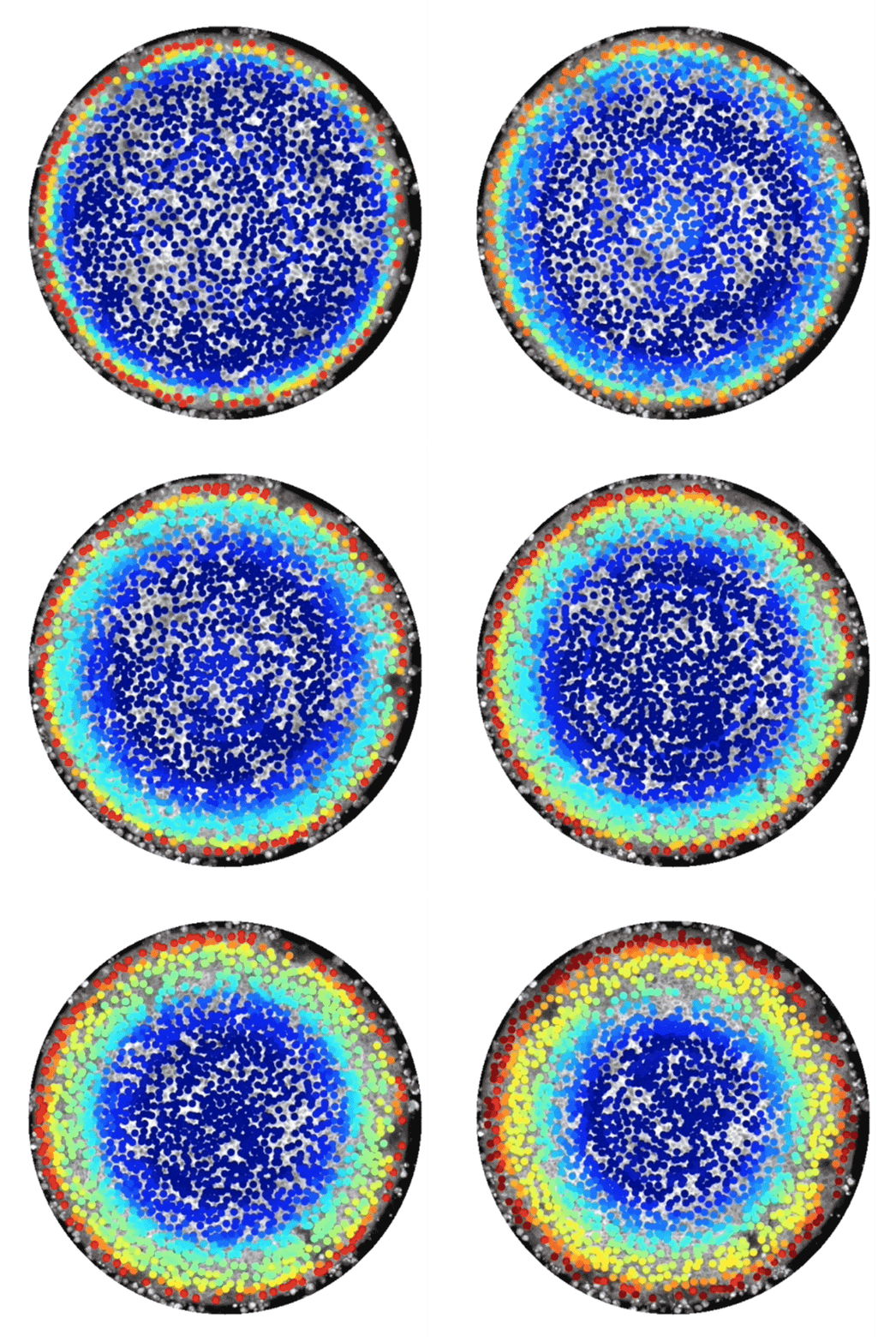
Waves of signalling in this embryoid — stronger signals in cerise and xanthous, and weaker in blue — prompt cells to differentiate. Credit: Idse Heemskerk and Aryeh Warmflash, Rice University
Follow-upwardly studies of the system accept already revealed new details nearly how embryonic cells employ geometry and chemistry to cocky-organize into singled-out tissue types. In 2016, Brivanlou, Siggia and their teams demonstrated5 that stalk cells tin sense their position in the circular colonies and, appropriately, adjust how they reply to molecules called growth factors, helping to form detached zones of cells. And in a preprint posted to the bioRxiv server in 2017, Warmflash's grouping at Rice University in Houston, Texas, demonstrated that the dynamics of growth factors have a office, too; the researchers saw that a surge in signalling by a item gear up of proteins — collectively chosen the Nodal pathway — spreads from the colony perimeter inwards like a wave, leaving different cell types in its wakehalf-dozen.
Brivanlou's grouping has taken the system even farther, showing in May7 that treating these types of colonies with a combination of growth factors induces the formation of 'organizer' cells. In animals, these special cells straight their neighbours to class a head-to-tail axis. Merely, in part considering of the 14-24-hour interval rule, scientists had never seen homo organizer cells in action. Given the ethical and technical limitations of working with human embryos, Brivanlou instead grafted clusters of putative human organizer cells onto developing chick embryos, and watched every bit the grafted cells directed chick cells to develop into a second chicken nervous organisation.
Life support
Much research on early human development has focused on the embryo itself, merely many other tissues are crucial to its survival. These include the amniotic sac, which houses the embryo, and the placenta, which provides oxygen and nutrients.
To better study how the amniotic sac develops, researchers created a model using man stalk cells. Last year8, developmental biologist Deborah Gumucio and bioengineer Jianping Fu at the Academy of Michigan in Ann Arbor and their colleagues showed that when they grew human stem cells on a gel bed and surrounded them with natural scaffold molecules, the cells self-organized into a dodder resembling the amniotic sac. After about 24 hours, a hole opened upward and, subsequently, cells began to flatten on one side and elongate on the other, feature of the procedure leading up to gastrulation.
The model replicates only the cadre of the embryo and its sac, with none of the other supporting tissues it would demand to be viable; however, the researchers were all the same able to identify some of the molecular signals that could help to give rise to this asymmetrical structure. "There'southward then much good information to exist plant, there'due south no reason to button this in whatsoever way to get close to making embryos," says Gumucio. The scientists maintained their embryo-like cultures for upwardly to 5 days, corresponding roughly to developmental days 9–14, at which point they ended the experiments.
Zernicka-Goetz's squad is trying to develop more-complete structures. In 2017, the team cultured a combination of ii types of mouse stem cell: those that grade the embryo itself, and some that assistance to class the placenta, called trophoblast stem cells. Embedded in a 3D scaffold, this synthetic structure grew to resemble the embryo subsequently implantation9. Now, the researchers are working on creating a like embryo-like construct using homo stem cells. Such a development could aid scientists to learn more than near the cantankerous-talk between embryonic tissues and extraembryonic ones, such equally the placenta.
As some labs develop these increasingly sophisticated constructed models, called embryoids, ethical questions are beginning to chimera up. "I think it really is a gray area," says Martin Pera, a stem-jail cell biologist at The Jackson Laboratory in Bar Harbor, Maine. "How do nosotros regard these structures that are developing?" Many ethicists and scientists agree that electric current versions of synthetic embryoids are too simplistic to fall under the 14-mean solar day rule. But bioethicist Insoo Hyun at Case Western Reserve University in Cleveland, Ohio, says that it's a challenge to define which features would make embryoids just realistic plenty. "The potential is there for something to exist constructed that's much further along than 14 days, and that could develop if you were to implant it into the uterus."
Body building
Researchers are likewise making strides in unlocking details from later phases. Many of these advances come up from improve tissue staining and imaging. In a 2016 report in Science, researchers at the University of Amsterdam'south Bookish Medical Heart digitized xv,000 slices from a collection of tissues maintained by the Carnegie Institution for Scientific discipline in Washington DC. The collection houses samples obtained from miscarriages, surgeries and autopsies, beginning in the 1880s and standing over the first half of the twentieth century. In the Dutch written report10, which spans the first ii months of development, the researchers digitally traced the outlines of up to 150 organs on individual slices, and so aligned the sections to reconstruct 3D models of the original embryo, available as an interactive atlas.
Studying the embryos in high resolution has already led to a few discoveries. For instance, the team foundten that the kidneys, which are thought to ascend, and the gonads, which are thought to descend during evolution, simply seem to ascension and fall within the trunk because they grow at different rates compared to the vertebrae.
But one major limitation of the Carnegie collection is its lack of molecular markers, which makes information technology difficult to distinguish different jail cell types. To address these issues, Alain Chédotal at the French National Establish of Health and Medical Enquiry (INSERM) in Paris published in 2017 a new 3D atlas of 36 human embryos and fetuses spanning weeks 6–fourteen of development11. Chédotal and his team applied a tissue-clearing treatment to the donated specimens to make the samples easier to image under a microscope, and they stained them to highlight various cell types.

As nerves develop, they adopt different branching patterns in the left and right easily. Credit: Alain Chédotal/Morgane Belle/Fondation Voir et Entendre
The resulting 3D images prove, in high-resolution detail, developing nerves, muscles, lungs, and other organs. "In terms of item, in that location was nothing like that before," says Rui Diogo at Howard University College of Medicine in Washington DC, who has mined the data set up for information on how limb muscles develop.
In still unpublished results, Diogo'south squad has observed a number of hand and pes muscles that disappear or fuse during development. "When we are embryos, we take muscles we don't have every bit adults," he says. Among other unexpected findings, Chédotal reported that, although the gross arrangement of nerves is like in the left and right hands, the fine branching patterns in each mitt diverge and strike out forth unlike paths in the first vii–11 weeks.
Developing field
Every bit scientists refine and improve their techniques, they hope to learn much more than near human development, and to shed light on the causes of pregnancy loss and birth defects.
Equally an embryo's earliest days come into sharper focus, so likewise practise discussions of the ethical limits. Zernicka-Goetz'due south and Brivanlou'due south extended experiments take led some to propose that the time is ripe to re-evaluate the pros and cons of the 14-day rule. In May, the Baker Found Center for Wellness and Biosciences at Rice University hosted a meeting of xxx United states of america scientists, ethicists and other experts, including Brivanlou and Johnston, to hash out whether and how to motility the boundary. "I think it's ameliorate to keep the fourteen-twenty-four hours rule in place and have a special petition to brand an exception," says Hyun, who also attended the outcome.
As the results of this research accrue, the technical advances are inspiring a mixture of fascination and unease among scientists. Both are valuable reactions, says Johnston. "That feeling of wonder and awe reminds us that this is the earliest version of human being beings and that's why then many people accept moral misgivings," she says. "It reminds the states that this is non just a couple of cells in a dish."
Is It Possible to Grow Your Baby in a Lab
Source: https://www.nature.com/articles/d41586-018-05586-z

Post a Comment for "Is It Possible to Grow Your Baby in a Lab"