What Does It Mean for a Function to Be Differentiable at a Point
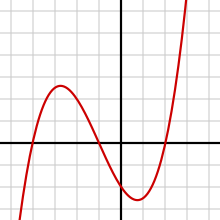
A differentiable function
In mathematics, a differentiable office of one existent variable is a part whose derivative exists at each point in its domain. In other words, the graph of a differentiable part has a non-vertical tangent line at each interior point in its domain. A differentiable function is smooth (the function is locally well approximated as a linear part at each interior point) and does not comprise whatsoever break, angle, or cusp.
If 10 0 is an interior signal in the domain of a part f, then f is said to be differentiable at x 0 if the derivative exists. In other words, the graph of f has a non-vertical tangent line at the point (10 0, f(x 0)). f is said to exist differentiable on U if information technology is differentiable at every betoken of U. f is said to be continuously differentiable if its derivative is also a continuous function. Generally speaking, f is said to be of class if its first derivatives exist and are continuous.


Differentiability of real functions of one variable [edit]
A function , defined on an open ready , is said to be differentiable at if the derivative


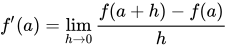
exists. This implies that the function is continuous at a.
This function f is said to be differentiable on U if it is differentiable at every point of U. In this instance, the derivative of f is thus a part from U into

A continuous function is not necessarily differentiable, but a differentiable function is necessarily continuous (at every point where it is differentiable) as being shown below (in the department Differentiability and continuity). A office is said to be continuously differentiable if its derivative is also a continuous role; in that location exists a office that is differentiable but not continuously differentiable equally existence shown beneath (in the section Differentiability classes).
Differentiability and continuity [edit]
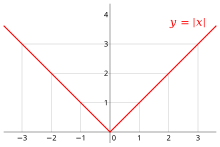
The accented value function is continuous (i.e. it has no gaps). Information technology is differentiable everywhere except at the signal x = 0, where information technology makes a sharp turn equally it crosses the y -axis.

A cusp on the graph of a continuous function. At zero, the office is continuous only non differentiable.
If f is differentiable at a betoken 10 0 , then f must also be continuous at ten 0 . In particular, any differentiable office must be continuous at every point in its domain. The converse does not hold: a continuous function demand non exist differentiable. For example, a part with a bend, cusp, or vertical tangent may be continuous, but fails to exist differentiable at the location of the bibelot.
Most functions that occur in practice have derivatives at all points or at almost every point. However, a result of Stefan Banach states that the set of functions that accept a derivative at some point is a meagre set in the space of all continuous functions.[1] Informally, this means that differentiable functions are very atypical among continuous functions. The first known example of a function that is continuous everywhere only differentiable nowhere is the Weierstrass function.
Differentiability classes [edit]
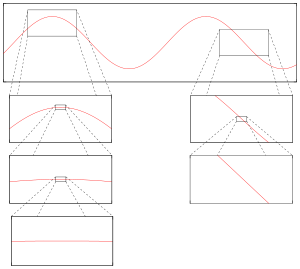
Differentiable functions can be locally approximated by linear functions.
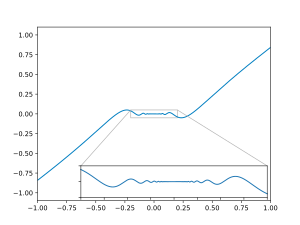
The function with for and is differentiable. Even so, this office is non continuously differentiable.




A office is said to be continuously differentiable if the derivative exists and is itself a continuous part. Although the derivative of a differentiable office never has a spring discontinuity, it is possible for the derivative to have an essential discontinuity. For example, the function



is differentiable at 0, since
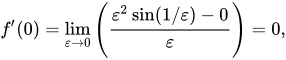
exists. Notwithstanding, for differentiation rules imply


which has no limit as Thus, this instance shows the being of a role that is differentiable only not continuously differentiable (i.e., the derivative is non a continuous function). Nevertheless, Darboux's theorem implies that the derivative of any function satisfies the determination of the intermediate value theorem.

Similarly to how continuous functions are said to be of class continuously differentiable functions are sometimes said to exist of grade A office is of class if the first and 2nd derivative of the function both be and are continuous. More than generally, a role is said to be of class if the first derivatives all exist and are continuous. If derivatives exist for all positive integers the function is smooth or equivalently, of class


Differentiability in higher dimensions [edit]
A function of several existent variables f: R chiliad → R n is said to be differentiable at a point x 0 if there exists a linear map J: R grand → R due north such that

If a function is differentiable at x 0 , then all of the partial derivatives exist at 10 0 , and the linear map J is given past the Jacobian matrix. A similar formulation of the higher-dimensional derivative is provided past the central increment lemma found in single-variable calculus.
If all the partial derivatives of a function exist in a neighborhood of a indicate x 0 and are continuous at the bespeak x 0 , then the role is differentiable at that signal x 0 .
However, the existence of the partial derivatives (or even of all the directional derivatives) does not guarantee that a part is differentiable at a betoken. For example, the part f: R 2 → R defined past
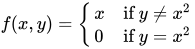
is not differentiable at (0, 0), only all of the partial derivatives and directional derivatives exist at this signal. For a continuous case, the function

is not differentiable at (0, 0), but again all of the fractional derivatives and directional derivatives exist.
Differentiability in circuitous analysis [edit]
In circuitous analysis, circuitous-differentiability is defined using the same definition as single-variable real functions. This is allowed past the possibility of dividing complex numbers. So, a role is said to exist differentiable at when


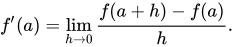
Although this definition looks like to the differentiability of single-variable real functions, it is nevertheless a more than restrictive condition. A function , that is circuitous-differentiable at a point is automatically differentiable at that bespeak, when viewed as a function . This is because the circuitous-differentiability implies that


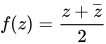
Even so, a function tin be differentiable every bit a multi-variable function, while not being complex-differentiable. For example, is differentiable at every indicate, viewed as the 2-variable real role , only it is non complex-differentiable at whatever point.

Whatever role that is complex-differentiable in a neighborhood of a point is chosen holomorphic at that point. Such a part is necessarily infinitely differentiable, and in fact analytic.
Differentiable functions on manifolds [edit]
If M is a differentiable manifold, a real or complex-valued function f on M is said to be differentiable at a point p if it is differentiable with respect to some (or whatsoever) coordinate chart divers around p. If M and N are differentiable manifolds, a function f:Grand →N is said to exist differentiable at a bespeak p if it is differentiable with respect to some (or any) coordinate charts defined around p and f(p).
See likewise [edit]
- Generalizations of the derivative
- Semi-differentiability
- Differentiable programming
References [edit]
- ^ Banach, S. (1931). "Über die Baire'sche Kategorie gewisser Funktionenmengen". Studia Math. 3 (1): 174–179. . Cited by Hewitt, Eastward; Stromberg, G (1963). Real and abstruse assay. Springer-Verlag. Theorem 17.8.
Source: https://en.wikipedia.org/wiki/Differentiable_function#:~:text=In%20mathematics%2C%20a%20differentiable%20function,interior%20point%20in%20its%20domain.

Post a Comment for "What Does It Mean for a Function to Be Differentiable at a Point"